
Chemical engineering
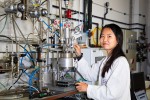
The "Chemical Engineering" engineer designs, sizes, and controls equipment to carry out chemical or biological reactions and product separations. This includes risk management, process safety, and minimizing environmental impact. They work in the field, operate within multidisciplinary teams, oversee all stages of industrialization, and analyze various issues from startup to production management.
Check out the syllabus (in French)
Objectives
ENSIACET “Chemical Engineering” major aims to train and certify engineers whose skills span from the fundamentals of chemical reactions, design and management of the related process to shaping and packaging. The engineering curriculum of this major has a double target. Firstly, its objective is to give theoretical knowledge as well as working methods to approach the specificities of a technique. Secondly, it gives the necessary knowledge to be able to broaden engineers' responsibilities.
Features
- A balanced curriculum between chemistry and process engineering
- Importance given to lab work
- A curriculum based on sustainable development
- Different professions in varied activity sectors
- Strong support by the research lab in Chemical Engineering (Laboratoire de Génie chimique)
Skills
- Master the analytical tools applied to processes
- Understand the problems linked to development: from chemical reaction to production
- Size the systems used for physical, chemical or biological transformations
- Analyze, optimize and control the processes
- Take into account the quality, risk management, safety and sustainability factors
Course subjects
23% Chemistry : Organic, Inorganic, Theoretical, Polymers, Analytical, Spectroscopy, Life Sciences
23% Engineering : Balance, Thermal engineering, Reaction engineering, Separation techniques (distillation, absorption, extraction,...), Process control
13% Humanities : English, Physical Education, Conferences
20% Physics : Thermodynamics, Kinetics, Fluid mechanics, Transport phenomena (mass and heat transfer)
13% Math and computer science : Applied mathematics, Programing, Numerical computation
8% Engineering professions : Quality Health Safety Environment, Economy, Knowledge of the companies, Communication
Third-year core curriculum
In the first semester of the third year, the school offers a core curriculum shared by all five specializations (Chemistry, Materials, Chemical Engineering, Process Engineering, and Industrial Engineering). This core curriculum provides students with a comprehensive understanding of matter and energy transformation, reflecting the hallmark of the ENSIACET engineer: an open and interdisciplinary profile.
 Génie chimique_FISE_année1_semestre2_ECTS 2025-2026.pdf
 http://www.enseignementsup-recherche.gouv.fr/
 https://www.cti-commission.fr/
 https://www.cti-commission.fr/la-cti/demarche-qualite/systeme-qe/eur-ace
 https://www.univ-tlse3.fr/
 https://www.groupe-inp.fr/
 https://www.aia7.fr/fr/
 https://20ecolesdechimie.com/
 https://www.cge.asso.fr/
 https://www.cdefi.fr/
 https://midisup.com/
 https://www.cnrs.fr/fr
 https://www.inrae.fr/