
Engineering in chemistry
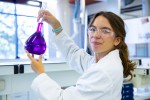
ENSIACET engineers in chemistry develop strategies to synthesize complex molecules with tailored functional properties, using either synthetic reactants or renewable resources. They also master advanced analytical tools to characterize molecules and target products. Through interdisciplinary team projects, their approach integrates economic constraints and environmental impacts from the outset, ensuring sustainable and efficient chemical processes.
Objectives
ENSIACET “Engineering in chemistry” major aims to train and certify skilled engineers for the synthesis, analysis, characterization and industrial implementation of complex molecules and target products in the context of sustainable and responsible chemistry. This engineering curriculum develops knowledge, skills and work best practices to address any technical concerns and to assume different responsibilities.
Features
- Research and development of new efficient and reliable products and processes which respect human health and the environment.
- Mastery of methods and analytical tools to follow reactions, study product properties and estimate their environmental impact.
- Understanding of matter behaviour (how it creates and transforms itself).
- Experience in creating new molecules and materials with innovating properties.
- Ability to take up challenges to fight against pollution, create new medicines and develop new energy sources.
Skills
- Analyse and characterize the functional properties of products and assess their environmental impact (Life Cycle Analysis, Carbon footprint and eco-toxicity).
- Create and develop synthesis strategies to meet the demands of high efficiency and reaction selectivity in the context of sustainable and responsible chemistry.
- Master analytical tools applied to the separation, identification, characterisation and quantification of molecules or target products (fields of synthesis and process).
- Take into account demands related to the
Course subjects
- 50% Chemistry : Organic, Inorganic, Theoretical, Polymers, Analytical, Electrochemistry, Environmental Chemistry, Biochemistry
- 19% Engineering sciences : Chemical reactors, Unit Operations, Molecular simulation, Corrosion, Heterogeneous catalysis, Materials, Nuclear physic-chemistry
- 10% Humanities : English, Physical Education, Conferences
- 8% Engineering professions : Quality Health Safety Environment, Economics, Business Knowledge,Communication
- 8% Math and computer science : Applied mathematics, Programming, numerical computation
- 5% Physics : Thermodynamics, Kinetics, transfer phenomena (thermal and heat diffusions)
Third-year core curriculum
In the first semester of the third year, the school offers a core curriculum shared by all five specializations (Chemistry, Materials, Chemical Engineering, Process Engineering, and Industrial Engineering). This core curriculum provides students with a comprehensive understanding of matter and energy transformation, reflecting the hallmark of the ENSIACET engineer: an open and interdisciplinary profile.
 Chimie_année1_semestre2_ECTS 2025-2026.pdf
 http://www.enseignementsup-recherche.gouv.fr/
 https://www.cti-commission.fr/
 https://www.cti-commission.fr/la-cti/demarche-qualite/systeme-qe/eur-ace
 https://www.univ-tlse3.fr/
 https://www.groupe-inp.fr/
 https://www.aia7.fr/fr/
 https://20ecolesdechimie.com/
 https://www.cge.asso.fr/
 https://www.cdefi.fr/
 https://midisup.com/
 https://www.cnrs.fr/fr
 https://www.inrae.fr/